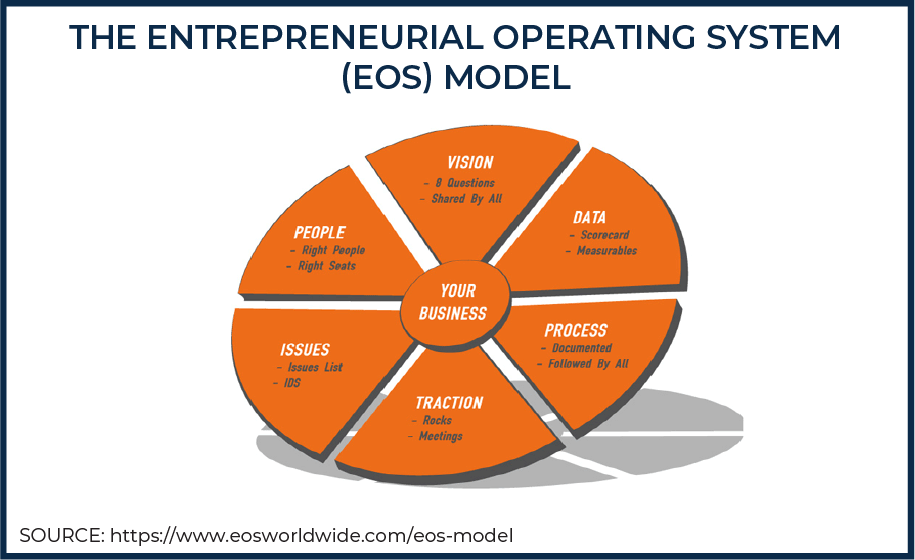
One of the most common conversations I have with founders begins with some version of:
“We have implemented EOS, but we’re not getting the results we expected.”
The leadership team is holding L10 meetings. Rocks have been established. Scorecards exist. Accountability charts are in place. Quarterly planning sessions happen consistently.
On paper, everything appears to be working.
Yet execution remains inconsistent. The same issues continue to surface. Rocks get pushed into the next quarter. Accountability feels weak. Leaders attend meetings but leave without meaningful progress. The founder is still involved in too many decisions and too much of the accountability.
At this point, many founders begin questioning EOS.
In my experience, EOS is rarely the problem.
More often, the organization has installed the tools without fully embracing the leadership discipline required to make the tools effective.
EOS Is A Framework, Not A Solution
One of the biggest misconceptions about EOS is that implementing the tools will automatically improve execution.
EOS provides a framework for:
- Creating focus
- Establishing accountability
- Solving issues
- Aligning leadership teams
- Creating operating discipline
What EOS does not do is make leaders accountable.
It does not force difficult conversations. It does not solve issues. It does not make decisions. It does not hold people accountable for commitments.
The leadership team still has to do those things.
The framework creates the opportunity for traction. The leadership team creates the traction.
That distinction is important because many organizations become frustrated when they install EOS but fail to see meaningful changes in performance. The tools are visible. The behaviors remain unchanged.
Common Signs EOS Is Not Working
Most founders know when EOS is not producing the results they expected.
The symptoms are often easy to recognize:
- L10 meetings feel like status updates.
- The same issues appear week after week.
- Rocks are consistently carried into the next quarter.
- To-Dos are frequently missed.
- Scorecards are reviewed but rarely drive decisions.
- Leaders avoid difficult conversations.
- Accountability feels inconsistent across the leadership team.
- Progress still depends heavily on founder involvement.
None of these issues are caused by EOS.
They are indicators that the organization is using the tools without fully adopting the discipline behind them.
The Difference Between Using EOS And Living EOS
Many businesses use EOS.
Far fewer businesses truly operate on EOS.
The difference is significant.
Organizations that are simply using EOS often focus on the mechanics:
- Running meetings
- Updating scorecards
- Setting Rocks
- Maintaining accountability charts
Organizations that are living EOS focus on the behaviors that make the tools effective:
- Solving issues at the root cause level
- Making decisions quickly
- Holding one another accountable
- Following through on commitments
- Maintaining focus on priorities
- Addressing difficult conversations directly
The tools support the behaviors.
The tools are not a substitute for the behaviors.
This is where many leadership teams get stuck. They assume the framework itself will create accountability when accountability is actually a leadership responsibility.
Why The Same Issues Keep Coming Back
One of the clearest signs that EOS is not working as intended is repetition.
Founders often describe it as feeling stuck in the same conversations quarter after quarter. Customer issues continue to surface. Communication challenges remain unresolved. Accountability concerns never seem to disappear. The leadership team discusses the same frustrations repeatedly, yet very little actually changes.
This usually happens because leadership teams spend time identifying issues without fully solving them.
The conversation often follows a familiar pattern:
- An issue is raised.
- Team members share their perspectives.
- Possible causes are discussed.
- Everyone agrees the issue is important.
- The meeting moves on.
The problem remains.
Over time, organizations become very good at talking about issues and very poor at resolving them.
One of the most valuable lessons EOS teaches is that identifying an issue is not the same as solving it. Awareness creates visibility, but visibility alone does not create traction.
When issues continue resurfacing, it is often because the leadership team has not fully addressed the root cause. Instead, they are responding to symptoms.
For example:
- A communication problem may actually be an accountability problem.
- An accountability problem may actually be a role clarity problem.
- A role clarity problem may actually be a leadership capability problem.
- A missed Rock may actually be a prioritization problem.
If the team only addresses what is visible on the surface, the issue continues to return in different forms.
Strong leadership teams are willing to slow down long enough to identify the real issue, make a decision, assign ownership, and hold one another accountable for follow-through.
The purpose of IDS is not to discuss issues.
The purpose of IDS is to eliminate them.
The Hidden Cost Of EOS Lite
Many businesses operate in what I call “EOS Lite.”
The tools exist, but the discipline does not.
Meetings happen, but difficult issues are avoided. Scorecards exist, but nobody acts on the data. Rocks are established, but accountability remains inconsistent. To-Dos are assigned, but commitments are missed without consequence.
The organization receives some value from EOS, but never experiences the full benefit.
This creates a false sense of progress.
The leadership team believes it is operating on EOS because the tools are visible. Meanwhile, the behaviors that actually create traction remain unchanged.
The result is frustration:
- Founders begin questioning the framework.
- Leaders lose confidence in the process.
- Execution remains inconsistent.
- Progress slows.
- Founder dependency increases.
The business continues working harder than it should for the results it achieves.
A Simple EOS Health Check
If you are wondering whether EOS is working as intended, ask yourself the following questions:
- Are Rocks consistently completed each quarter?
- Are To-Dos completed every week?
- Are issues being solved rather than repeatedly discussed?
- Are scorecards driving decisions and accountability?
- Do leaders hold one another accountable without founder intervention?
- Is the leadership team aligned around the same priorities?
- Has execution improved since implementing EOS?
If several of these questions create discomfort, the issue is unlikely to be EOS itself.
More often, it is a leadership discipline problem.
What Strong EOS Execution Looks Like
When EOS is working properly, the impact becomes visible throughout the organization.
Leadership teams:
- Solve issues quickly.
- Make decisions faster.
- Maintain focus on priorities.
- Hold one another accountable.
- Complete commitments consistently.
- Address problems before they become crises.
- Operate with greater clarity and alignment.
Most importantly, the founder begins to experience leverage.
The business no longer relies on constant founder involvement to maintain momentum. The leadership team owns execution. Leaders make decisions. Accountability becomes part of the operating rhythm rather than something driven by the founder.
The founder can focus on vision, strategy, and the future of the business.
That is where EOS creates its greatest value.
Final Thought
EOS is a powerful framework.
But frameworks do not create results.
People do.
The organizations that achieve the greatest success with EOS are not the ones with the best scorecards, the most polished accountability charts, or the most organized meeting notes.
They are the organizations willing to embrace the discipline, accountability, and leadership behaviors required to make the framework work.
Because EOS does not create traction.
Leadership discipline creates traction.
EOS simply provides the structure to support it.
Leave a Reply